Key Takeaways
- A dedicated AI team gives you access to ML engineers, data scientists, and MLOps specialists in weeks instead of waiting months to hire them one by one.
- Eastern Europe remains one of the best-value regions for AI talent. To hire a dedicated team typically charges $50–95 per hour, while hiring comparable specialists in the US can cost $150–250 per hour once you factor in salaries, benefits, and recruiting.
- The right engagement model depends on the work. Choose a dedicated team for long-term product development, staff augmentation when you need a specific skill, or a project-based model for a well-defined PoC.
- Most AI projects don't fail because of the vendor. The main issue is that the scope isn't clear or the data isn't ready before development begins.
- When comparing partners, look beyond the sales pitch. Focus on their experience shipping AI systems to production, their MLOps capabilities, and how they handle data security.
Imagine a SaaS product planning to ship a new AI assistant by the end of the quarter. But there isn't a single ML engineer on the team. Leadership has promised the feature to customers, the roadmap is locked. Post a job and senior AI talent takes months to land. Hand it to the backend team and they learn on the clock. Either way, the deadline slips before the work starts.
This is where AI initiatives stall. The wrong choice ends in a proof of concept that never reaches real-world deployment, and budget spent with nothing shipped. For most companies facing a real mandate and deadline, bringing in AI development services for faster release and with less risk than building in-house from scratch. This guide covers what a dedicated AI development looks like — the roles, engagement models, and realistic costs. We’ll also take a look, how to hire a dedicated AI development team, choose a partner, and how Intellectsoft approaches the process.
What Is a Dedicated AI Development Team?
A dedicated AI development team is a group of AI and machine learning specialists — engineers, data scientists, MLOps, and QA — that a vendor assembles to work only on your product. Your partner handles hiring, retention, and management. But they work as one stable unit on your product, under your priorities, like an in-house team.
The dedicated team development can be confused with two other approaches.
- Staff augmentation: you add individual engineers to a team you already run. They report to your leads and work in your process. You manage them. In this way, you're topping up capacity, not handing off a function.
- Project-based outsourcing: you hand a defined scope to a vendor. The partner plans and staffs it, and delivers against a spec. People rotate on and off as their part finishes.
A dedicated team sits between them. The vendor employs the people, like in outsourcing. But you keep the continuity and direction of an in-house function and skip the permanent payroll.
Three things separate the models: who manages the people, who owns the outcome, and how you pay. Also, there are the signals you're ready for a dedicated team over an in-house build:
- You have an AI mandate and a deadline, but hiring senior AI talent would take months. Skilled ML and MLOps people are scarce. A dedicated team gives you a full unit in weeks.
- The work is ongoing and needs people who hold the context. Models drift and data changes. You need the same team over months, not a one-time build you're left maintaining alone.
- You want to run the work like your own team but not carry it forever. A dedicated team lets you steer now and commit to full headcount later — only if the mandate proves out.
In-House vs. Dedicated AI Team vs. Staff Augmentation — Decision Matrix
Hiring senior AI talent in-house is the slow and expensive path. In a March 2025 Bain & Company study, 44 percent of executives named a shortage of in-house AI expertise as a key barrier to deploying generative AI.
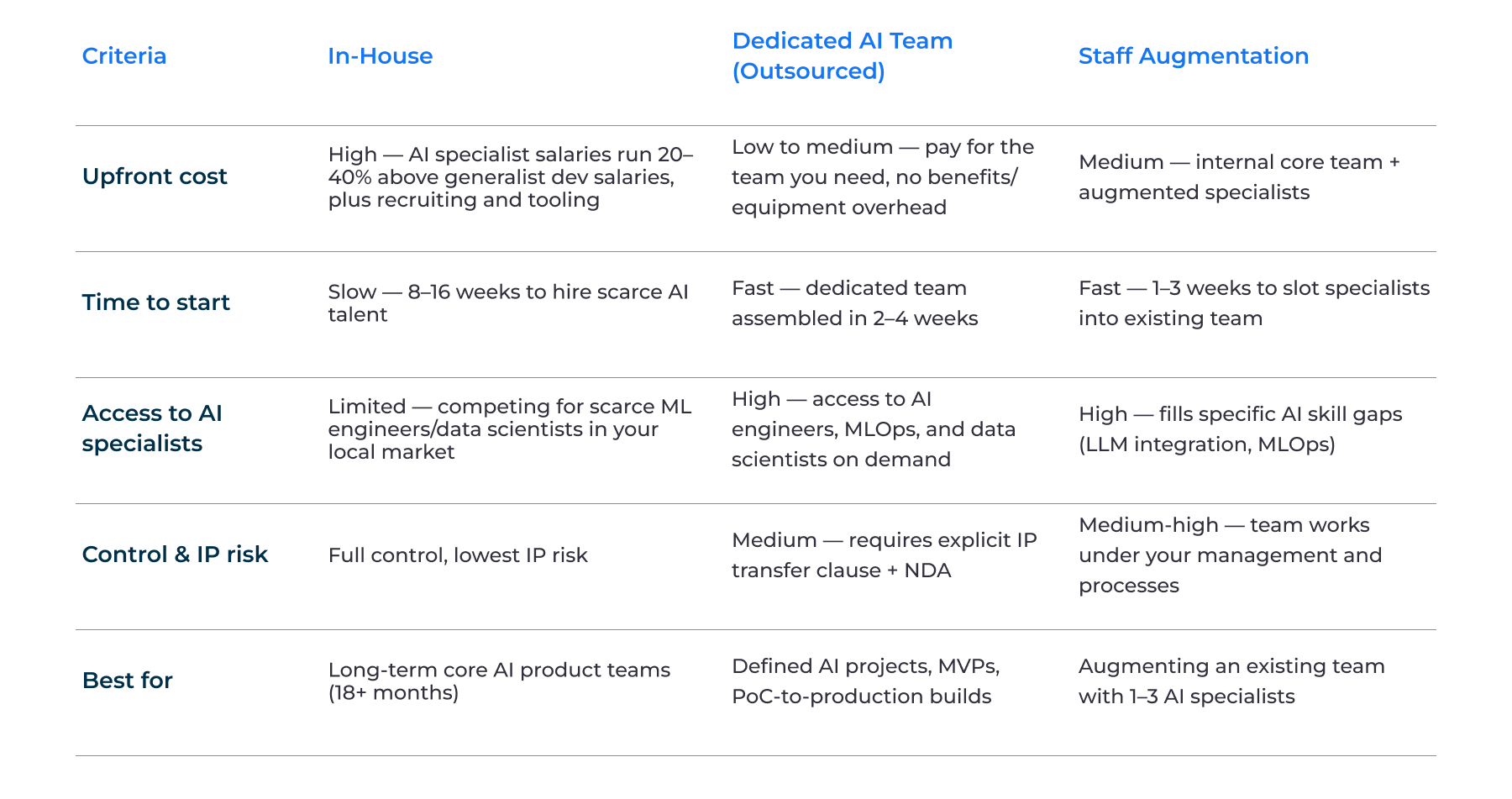
Not sure which model you need? The matrix for in-house vs. outsourcing comparison shows you three options on cost, speed, access to specialists, and control.
AI Development Team Structure: Key Roles
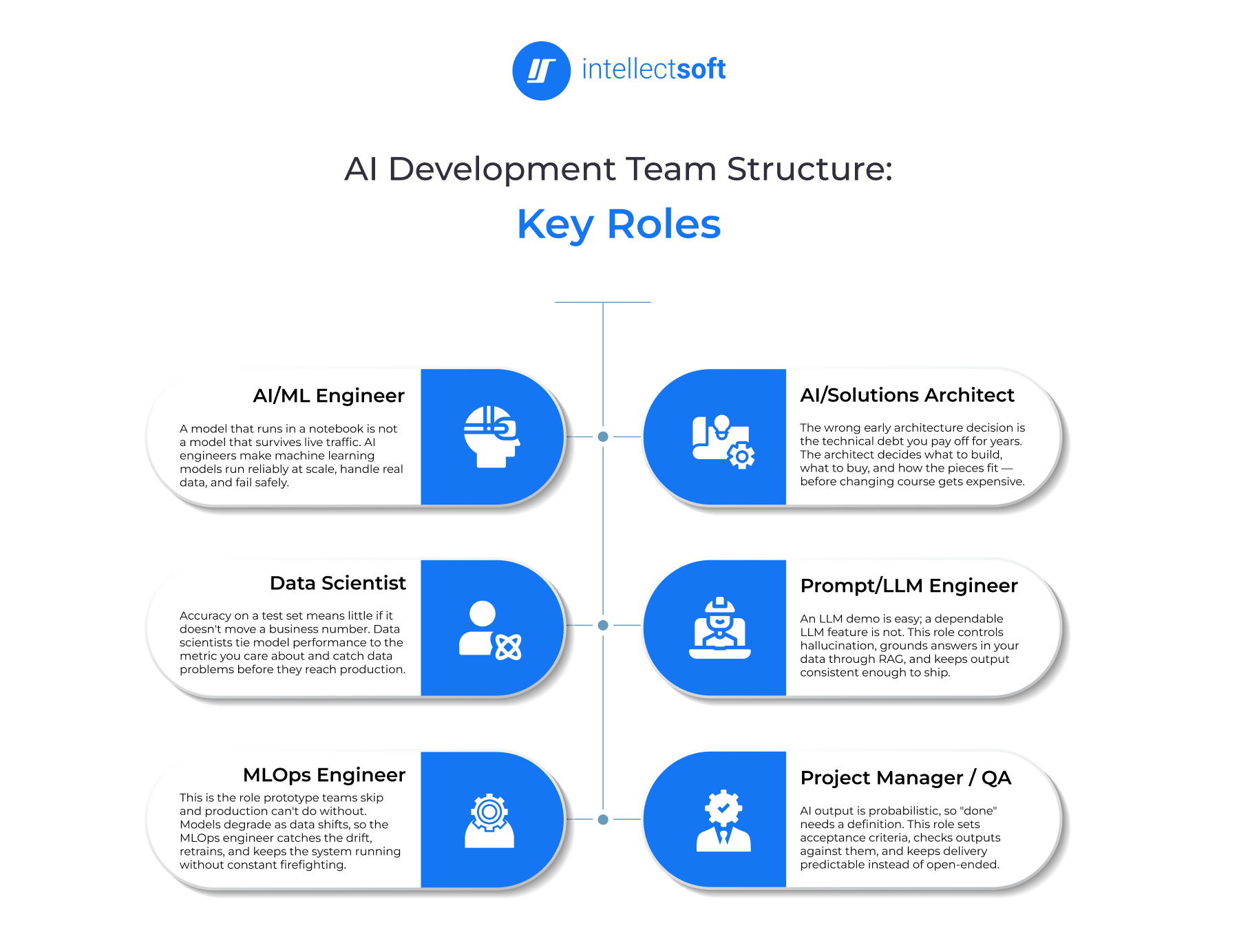
According to Gartner, only 48 percent of AI projects reach shipping to users, and getting there takes about eight months. And what crosses that gap is the full set of roles around it, each owning a different failure mode.
Here are the key roles in which an AI dedicated team can be formed.
AI Team Engagement Models — Which One Fits Your Project?
There's no single right way to hire for AI. So, the best model depends on two things: how well-defined your use case is and how long the initiative will run.
The three models below cover most cases.
Dedicated AI Development Team
A vendor assembles and manages a team of AI engineers, data scientists, and MLOps specialists who work only on your product. They handle the employment and support, and you direct the work. The difference is simple. One AI engineer eventually becomes a bottleneck. A dedicated team gives each area its own owner, so implementation, model quality, and deployment move in parallel. Implementation, model quality, and deployment move in parallel. In a dedicated development team they work from strategy through deployment and the ongoing retraining a live model needs.
This is the model for long-term AI product development because the people who hold that context need to stay and not rotate off after a sprint. The trade-off is commitment: a steady monthly cost and a real working relationship. Here, you won’t be able to quickly change the specialists or priorities. In return you get a team that knows your product, improves with it, and doesn't reset every time the scope changes.
AI Staff Augmentation
You add AI specialists straight into your existing team and run them like your own engineers. They work in your stack, your sprint cadence, and your process, pull tickets from your board, and report to your leads.
AI staff augmentation suits a team that is short of one skill: an MLOps engineer to stand up your deployment pipelines, an LLM specialist to build a single feature, a data engineer to fix the ingestion layer feeding your models. You're closing one gap and can scale that arrangement up or down without reopening a whole engagement.
The cost sits in oversight. Direction, onboarding, code review, and quality stay with your leads, and each specialist is only as productive as the priorities you set for them. Done well, it multiplies what a strong team can ship. But it won't rescue one that lacks the leadership to steer AI work in the first place.
Project-Based / PoC-to-Production
You hand a vendor a clearly scoped deliverable and a fixed timeline. They plan and staff it, and then ship against the spec. You stay in control of the outcome, but not the day-to-day management of the people building it.
Reach for this when you want proof before commitment. A proof of concept tests your real use case on your own data. Before the work starts, you agree on clear success criteria. The result is a simple go/no-go decision. That tells you whether the idea is worth scaling before you build a team around it.
What you give up is continuity. Commitment stays low and the scope stays fixed, but the moment the project closes the team moves on, and the context they built leaves with them. A PoC that works is only half the job: you still need a plan to carry it into production, or the real build starts cold.
How Much Does It Cost to Hire a Dedicated AI Development Team?
In theory, a dedicated team's rate sits above an in-house salary. But it was never the real cost of building the team yourself.
Hiring your own AI engineer means paying to find them first: months of search, recruiter fees, and the premium scarce AI talent commands over a generalist developer. Then you carry benefits, payroll overhead, tooling, and compute on top.
A dedicated team's rate folds most of that in. Recruiting, retention, and management sit with the vendor, and the cost starts when the team ships work, not when the search begins. So the real question isn't which rate is lower, but how quickly costs turn into working software.
Hourly Rates by Region
Here are the average cost ranges for dedicated team specialists worldwide:
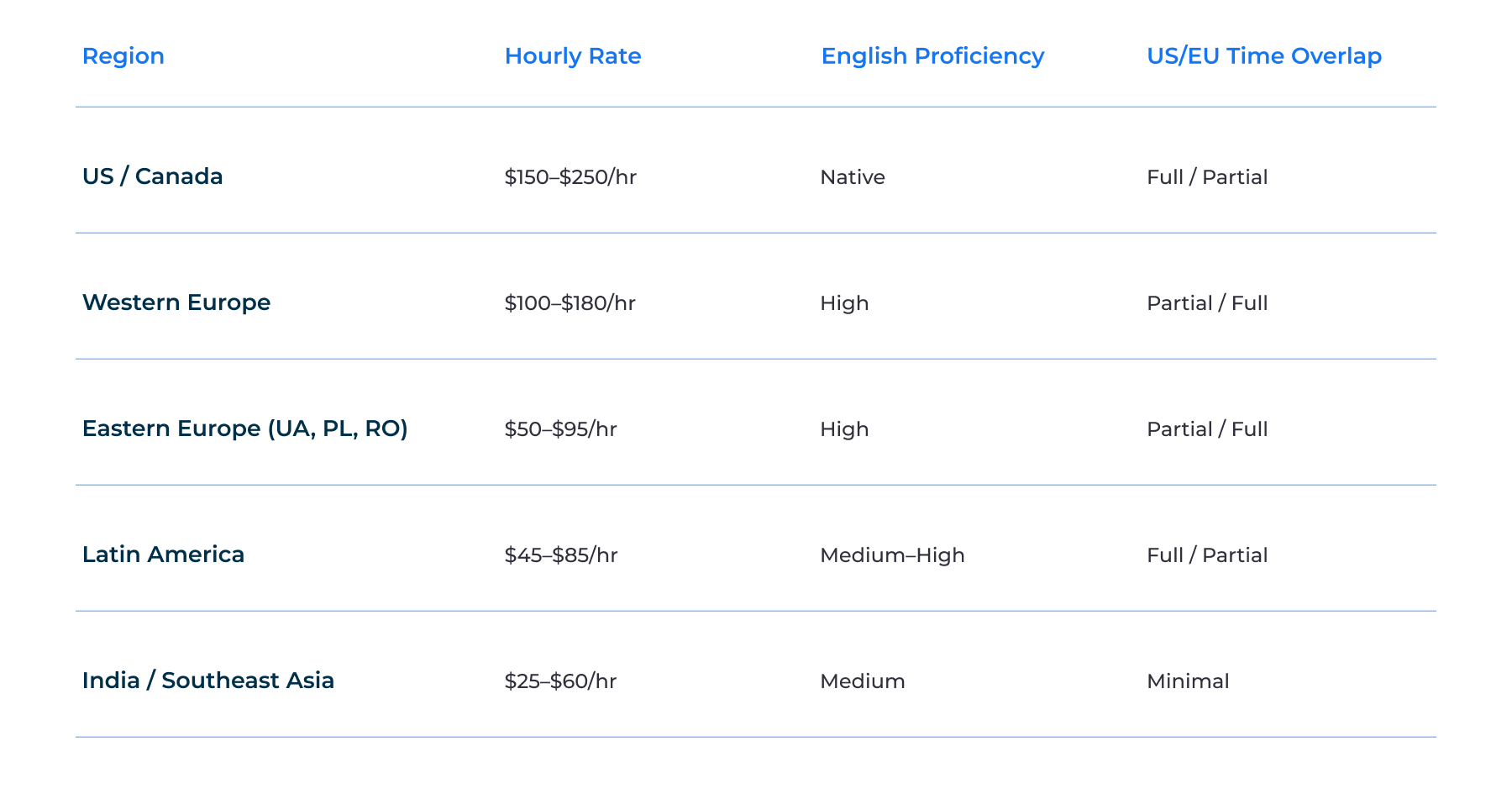
Actual project cost depends on scope, complexity, and your specific requirements. So, it can only be confirmed with a custom estimate.
Eastern Europe — Ukraine, Poland, and Romania — offers the strongest combination of AI and machine learning depth, English proficiency, and EU/US time zone overlap. For equivalent seniority, rates typically run at 40 to 60 percent of Western European or US levels.
Project Cost Ranges by Type
Depending on the size of the project, its cost is estimated as follows:
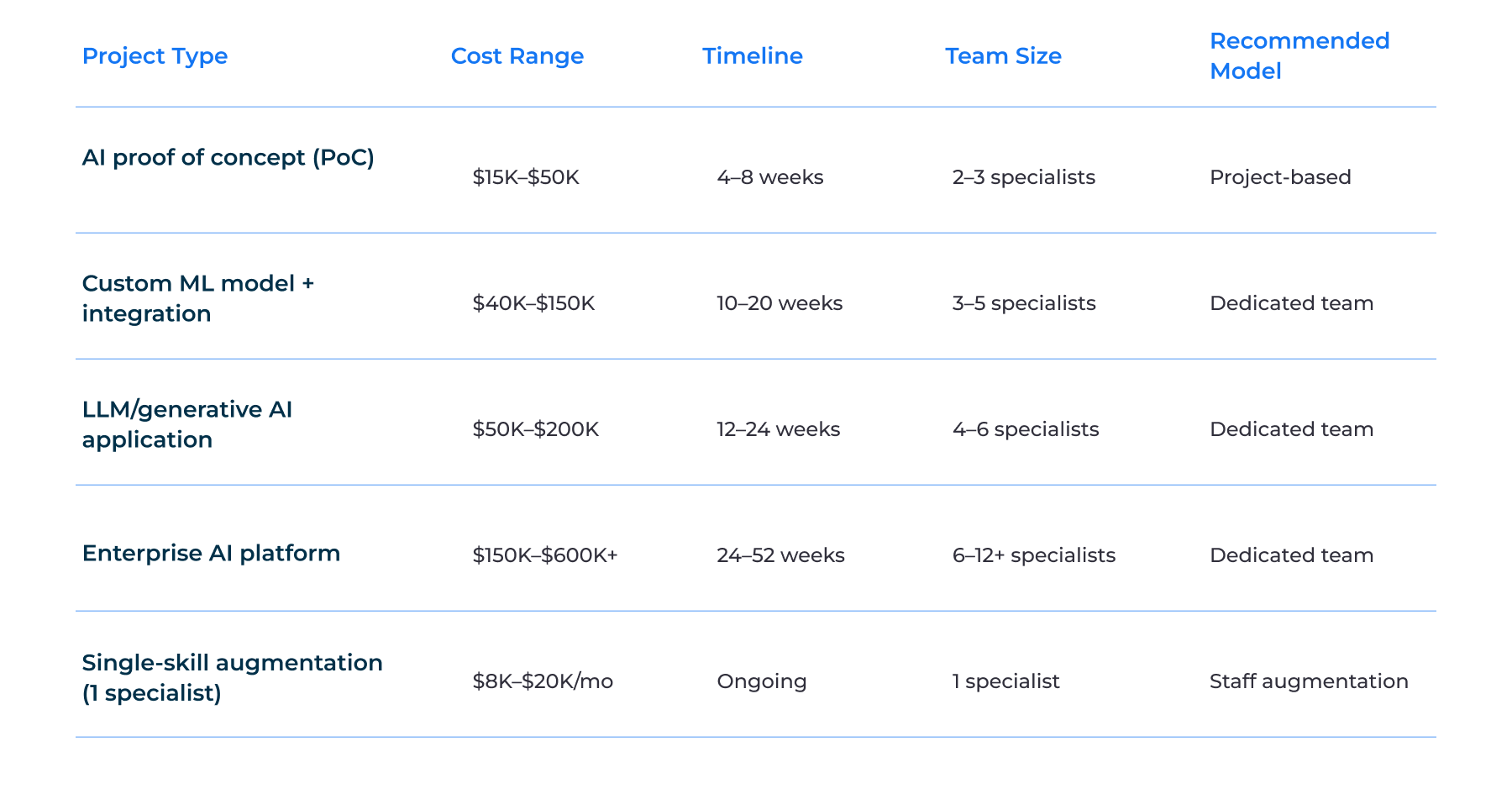
As with the hourly rates, where your project lands depends on its scope, complexity, and requirements.
These ranges cover typical dedicated-team engagements, and where you land in them comes down to scope. A single PoC at bespoke software development costs far less than a production-grade LLM application. An enterprise AI platform costs more than either. The price tracks how much you're building, not just how long you run the team.
In-House vs. Dedicated Team — The Real Cost Gap
The gap shows up before anyone ships a line of code. A senior US-based ML engineer runs roughly $180K to $250K a year fully loaded. For a similar outlay, a vendor can stand up a dedicated team of three to five AI specialists in weeks, at a fraction of that per-head cost.
- Recruiting scarce AI roles takes months and money. Your hiring manager's hours screening and interviewing, a recruiter's salary or agency fee, and the releases and launches that slip while the seat sits empty. Senior ML and MLOps specialists are the hardest roles to fill. Hiring them often takes months. A dedicated team is already staffed, so that cost line never opens.
- A new hire isn't productive on day one. Even a strong in-house hire needs weeks to ramp on your stack, data, and domain before the work compounds. A dedicated team brings people who have shipped this kind of work before.
- The tooling and infrastructure already exist. A first in-house hire often walks without any pipelines, monitoring, or environments — and has to build that foundation before any model ships. A partner brings the MLOps pipelines, monitoring, and environments in place, so you don't rebuild that foundation from scratch and wait on it.
- One or two in-house specialists are a single point of failure. When a single hire owns the whole initiative, one resignation or sick week can stall it outright. A team spreads the work and the knowledge across several people, so no one departure resets your progress.
Hidden Costs to Plan For
Launching an AI project has many hidden costs that can slow down production and release:
- Data preparation and labeling. Budget 15 to 25 percent of total project cost if your training data isn't already clean and labeled — the line item buyers underestimate most. Teams assume their data is model-ready. However, it's usually scattered across systems, inconsistent, and unlabeled, and a model only learns from what you feed it.
- MLOps and infrastructure. Vendors usually bill GPU compute, model hosting, and vector databases separately from the hourly rate. Because these are usage-based cloud costs that scale with your model rather than the team's time. Scope them explicitly, or they surface later as a surprise.
- Ongoing monitoring and retraining. Production models degrade as data drifts, so the build cost isn't the end of it. Budget for a monitoring and periodic retraining cadence from the start.
- Compliance and data governance review. Regulated industries like healthcare and finance need extra review cycles for data handling and model explainability. Your legal and finance teams spend real hours on sign-off, and that time is a cost of its own. Scan this in early, not as a change order once you're underway.
- Integration with existing systems. Connecting a model to production APIs, data pipelines, and legacy systems is routine but necessary operational work. It often takes longer than building the model itself.
- Change requests as the use case evolves. Early results tend to reshape what a project is actually aiming for, so scope shifts are normal. That’s why you need to budget 10 to 15 percent contingency for it.
Common Mistakes to Avoid When Hiring a Dedicated AI Development Team
Most failed AI hires come down to one of this mistakes, not a lack of talent:
- Starting without a clear use case. Without a defined problem and success metric, the engagement runs open-ended. As a result, it drifts, stalls, and burns budget.
- Skipping the data-readiness check. Unchecked data is the top cause of AI project delays. The gaps surface mid-build, when fixing them costs far more.
- Choosing the cheapest bid. An unusually low quote signals PoC-only experience, not production work. The shortcuts break after launch, under real users and real load.
- No MLOps plan from day one. Treat deployment as an afterthought and you get a model that runs in testing with no way to ship. Retrofitting a pipeline later is slower and messier.
- Underestimating domain expertise. A strong ML engineer without field context builds a technically correct model that misses the business nuance. Output that misreads the domain is output your team can't use.
- Ignoring monitoring after launch. A live model quietly loses accuracy as inputs shift away from its training data. With no monitoring, that decline surfaces only in your numbers.
- Leaving IP and data ownership unclear. If the contract doesn't name who owns the model, code, and derivative data, the ambiguity stays dormant until the relationship ends and becomes a dispute.
- Treating it as a one-off project. The strongest AI initiatives improve in cycles. A team that disbands at launch takes the context with it and freezes the work at its weakest version.
How to Hire a Dedicated AI Development Team — Step by Step
Hiring a dedicated AI team takes more than posting a role and picking a rate. It runs through a few distinct stages.
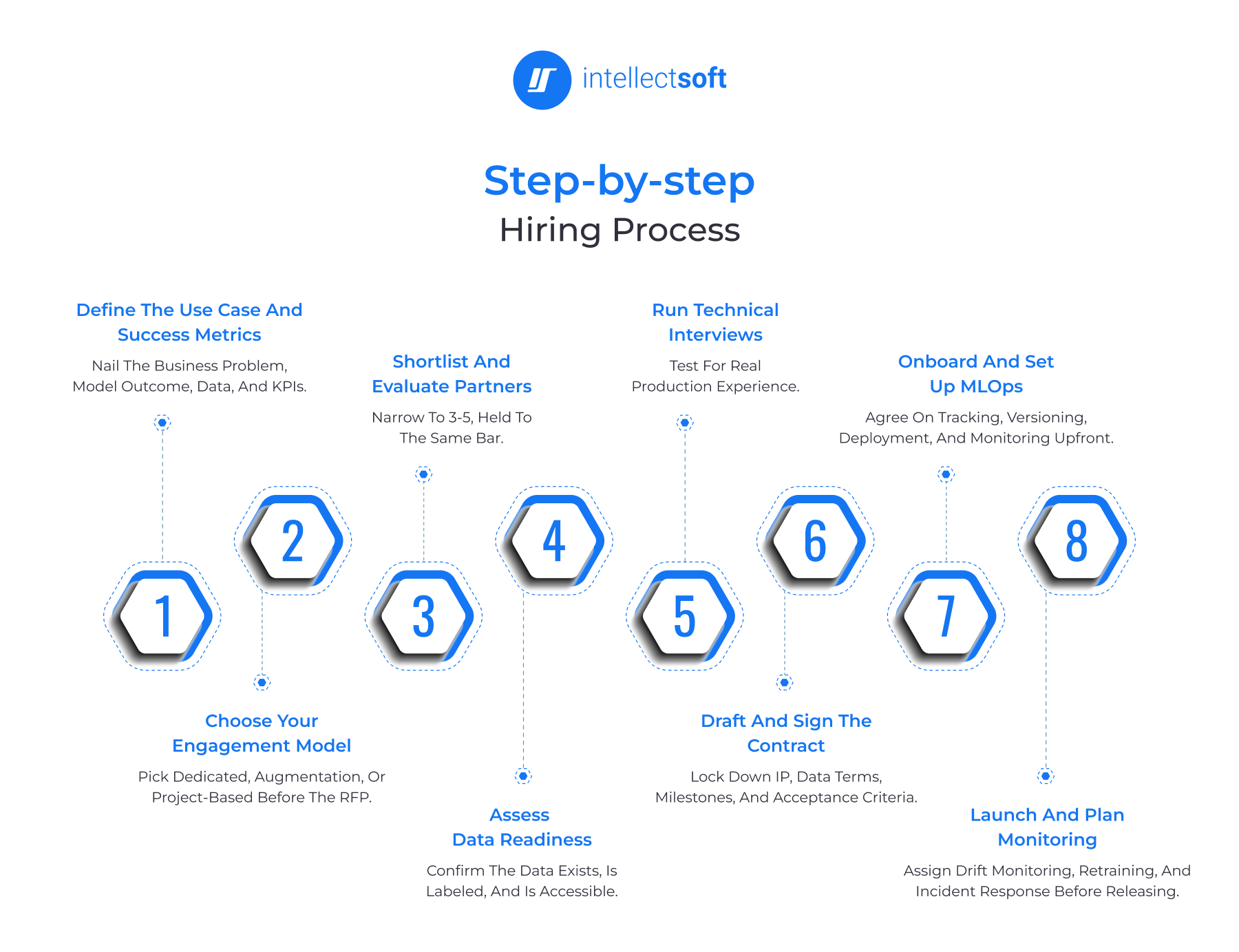
Step 1 — Define the AI Use Case and Success Metrics
Before you start talking to vendors, get clear on the problem you're trying to solve. Start with four questions:
- What business problem are you solving?
- What do you want the AI model to do?
- What data do you already have?
- How will you know the project succeeded?
For example, your support team spends hours routing tickets manually. In that case, your goal might be to classify each ticket by topic and urgency, then send it to the right person automatically.
Next, define what success looks like. Maybe you want to cut routing time from hours to seconds, keep misrouted tickets below five percent, or reduce first-response time by a third. Then take an honest look at your data. Do you have enough of it? Is it clean? Is it labeled correctly? Those answers will shape every decision that comes next.
Remember that a dedicated team can only scope, staff, and price against a defined target. If your brief is vague, you'll end up comparing proposals that solve different problems in different ways.
Step 2 — Choose Your Engagement Model
Decide how you want to work with the team before you issue an RFP. Each of the three models above serves a different kind of project.
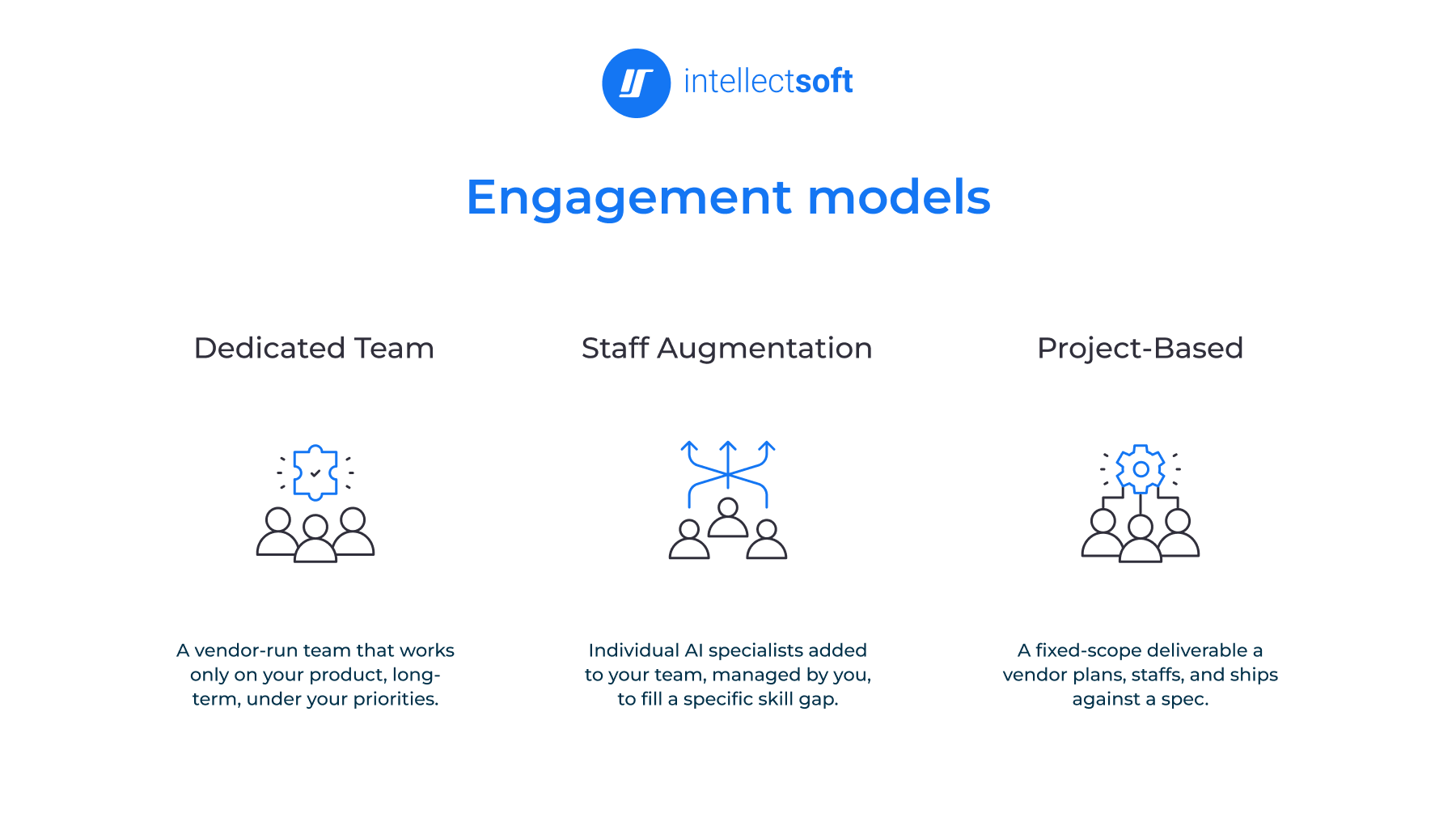
Then, match the model to the work. Choose a dedicated team for long-term AI product development. Pick staff augmentation to add one skill to a team you already run. Go project-based for a contained PoC with a fixed scope. Settle this first, and the RFP names one engagement structure. Vendors then quote the right pricing model: a monthly team rate, a fixed project bid, or per-head augmentation.
Step 3 — Shortlist and Evaluate AI Development Partners
Narrow the field to three to five partners and hold each to the same bar. The goal is simple: see past a polished pitch to whether they've actually shipped AI that runs in a live system.
Before hiring a dedicated team, evaluate every partner on four things:
- Production deployment experience, not just PoCs. Plenty of vendors can build a proof of concept. Far fewer have taken models into development and kept them running.
- MLOps maturity. Ask how AI developers handle deployment pipelines, monitoring, and retraining. A team without that discipline hands you a model you can't maintain.
- Data security practices. You're giving a partner access to your data. So, check how they store, handle, and govern it — especially in a regulated field.
- Verifiable case studies in a comparable domain. Look for named, checkable results in a field close to yours. Domain-adjacent experience cuts the time spent explaining your business before the work starts.
Step 4 — Assess Data Readiness
Before you commit a budget, check the data the project depends on. Confirm three things: the training and inference data exists, it's labeled, and the team can access it when the work starts.
This is the highest-ROI step in the process. Data problems are the most common reason AI projects slip, and they're far cheaper to catch now than mid-build. A gap you find here is a scoping note. The same gap found after kickoff is a stalled timeline and a change order. And if the data isn't ready, fixing it becomes the first phase of the work — so price that in now instead of discovering it later.
Step 5 — Run Technical Interviews
Hiring AI developers, interview them for applied experience. Ask what broke, how they caught it, and what they watched after launch. The failure modes and the monitoring are where real deployment experience shows. A candidate who only knows how a model works in theory hasn't faced what happens when it meets live traffic. The ones who have will name the edge cases they hit and the fixes they shipped, without prompting.
Step 6 — Draft and Sign the Contract
The contract is where you lock down what you're buying. Four terms carry the most weight. Each one closes an ambiguity that gets expensive to settle once work is underway.
- IP ownership of models and code. State plainly that you own the trained models, the code, and the derivative data. Silence here defaults nothing in your favor.
- Data handling and NDA terms. Define how the dedicated team stores, uses, and returns your data, backed by an NDA. In a regulated field, that's non-negotiable.
- Milestone-based payment schedule. Tie payments to delivered milestones, not the calendar. Cost then tracks progress instead of running ahead of it.
- A defined model-performance acceptance threshold. Agree up front on the metric and the number the model must hit to count as done.
Step 7 — Onboard and Set Up MLOps Workflows
Set up how the team will build and ship before development starts, not once models are in flight. Agree up front on four things: the experiment tracking tools, the model versioning approach, the deployment pipeline, and the monitoring cadence.
Then every experiment is tracked and every model version is traceable, and the path to a live environment exists before the first model ships. Leave it for later and the team has to wire these systems in around models that already exist. That catch-up costs more time than doing it first.
Step 8 — Launch and Plan Ongoing Model Monitoring
Decide who owns the model after launch before you go live. Name three owners up front: who watches for drift, what triggers a retraining cycle, and who responds when a model misbehaves.
Even a model that performs well at go-live loses accuracy over time, so drift monitoring, retraining triggers, and incident response each need an owner before that happens. Assign them ahead of go-live and the first performance drop is a routine retrain. Leave them unassigned and the same drop becomes an outage nobody was watching for.
How to Choose the Right AI Development Partner
Partner selection is the step that carries the result. The real differences between partners show in whether they've run AI in production, how they handle your data, and what they do when a model underperforms. The questions and red flags below help you tell those apart before you commit.
Questions to Ask Before Hiring an AI Development Partner
These six questions will show you if you are choosing the right team to collaborate with:
- What production AI systems have you deployed and maintained? Listen for named and live systems they've kept running over time.
- What is your MLOps stack and monitoring approach? A concrete answer, such as specific tools, pipelines, a monitoring cadence, tells you deployment is routine for them, not an afterthought.
- How do you handle data security and compliance? They should describe how they store, access, and govern your data. If you're in a regulated field, they should name the regulations they've worked under.
- Can we speak with two or three past AI customers? A partner confident in their work will connect you with references.
- What does your data-readiness assessment include? A strong partner checks your data before quoting, instead of assuming it's ready and billing for the surprise later.
- How do you handle model underperformance after launch? The honest answer is a clear process for catching the drop and retraining.
Red Flags to Avoid
Not every AI partner delivers work of the same quality. These red flags can be a reason to look closer before you commit:
- No mention of MLOps or monitoring. A partner who talks only about building models, never about running them, is likely a PoC shop with no path to release.
- A portfolio that's all PoCs, no production deployments. Proofs of concept show they can prototype. Without live, maintained systems, there's no proof they can ship.
- Vague answers on data security. If they can't clearly explain how they store, access, and govern your data, don't hand them access to it.
- No data-readiness assessment offered. A partner who quotes without checking your data is either inexperienced or setting up a change order once the gaps surface.
- Unusually low bids for AI work. A vendor who quotes without checking your data is either inexperienced or setting up a change order for when the gaps surface.
- Reluctance to share reference customers. A team proud of its work will connect you with the people it built that work for. Hesitation says the track record may not hold up.
Why Choose Intellectsoft for Your Dedicated AI Team
The hard part of AI is running a model reliably, keeping your data secure, and maintaining it after launch. That's the work Intellectsoft is built for software development services. Three things back it up:
- Architecture-led engagements. The deployment path and data handling are designed in from the start, not patched in later.
- Governed AI, not just fast. Automated code review and architecture risk scanning keep ungoverned model code out of production.
- A principal expert stays on. The people who scoped your system are the ones accountable for it running, not just present in the pitch.
Intellectsoft's AI Team Delivery Process
When you hire a dedicated AI development team from Intellectsoft, it works on your product alone, and the operational load stays with the vendor. That management layer includes:
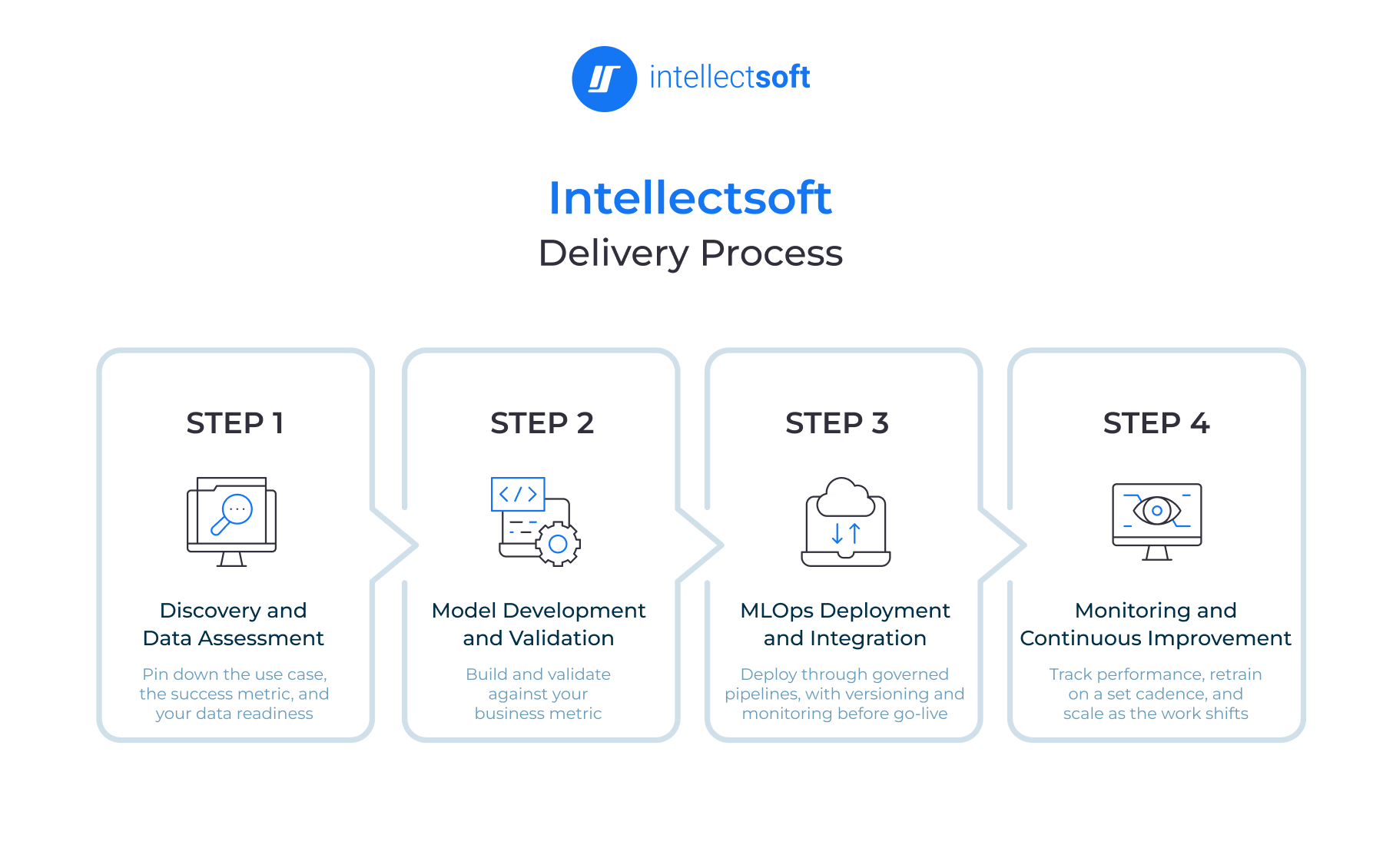
- Discovery and data assessment. We pin down the use case, the success metric, and whether your data is ready to train on, then plan the team's composition around it and bring in specialists for your specific domain and stack.
- Model development and validation. The team is allocated to your engagement alone and works as one unit. We build and validate against the business metric, so the model stays tied to the number you care about.
- MLOps deployment and integration. We deploy through governed pipelines and connect the model to your production systems, running on standard office and IT infrastructure we provide. Versioning and monitoring are in place before go-live.
- Monitoring and continuous improvement. After launch, we track performance, retrain on a set cadence, and keep the system accurate as your data changes. As the work shifts, we scale the team or move you to a fixed-scope arrangement, with replacements and knowledge transfer handled so no departure stalls progress.
Ready to build your AI initiative on a team that has done this in production? Book a free consultation, and we'll start with your use case and your data.
FAQ
What does it cost to hire a dedicated AI development team?
It depends on region and project type. Eastern European teams typically run $50 to $95 an hour for senior AI talent, well below US or Western European rates. Building the same capability in-house in the US costs more once you add salary, benefits, and recruiting.
What is the difference between a dedicated AI team and AI staff augmentation?
A dedicated team owns the full AI initiative end to end, managed by the vendor but working only on your roadmap. Staff augmentation adds individual specialists to your existing team, under your own management. Pick a dedicated team for long-term product work, augmentation to fill one skill gap.
How long does it take to assemble a dedicated AI development team?
A partner can usually shortlist and staff a team in two to four weeks. Hiring the same talent in-house takes roughly eight to 16 weeks, since senior ML and MLOps people are scarce and slow to close.
What roles are typically included in a dedicated AI development team?
A core team runs an AI/ML engineer, a data scientist, an MLOps engineer, and an AI architect, plus a PM or QA. LLM projects add a prompt/LLM engineer.
How do I evaluate an AI development partner's technical quality?
Look for production deployment experience. Check for a defined MLOps process covering monitoring and retraining, and ask for verifiable references in a domain close to yours.
